Know Your Boat Inside Out
Drag to rotate the 3D model. Click any glowing hotspot to see what that part actually does, what commonly goes wrong with it, and how we fix it the right way.
Loading 3D viewer...
Reference Views
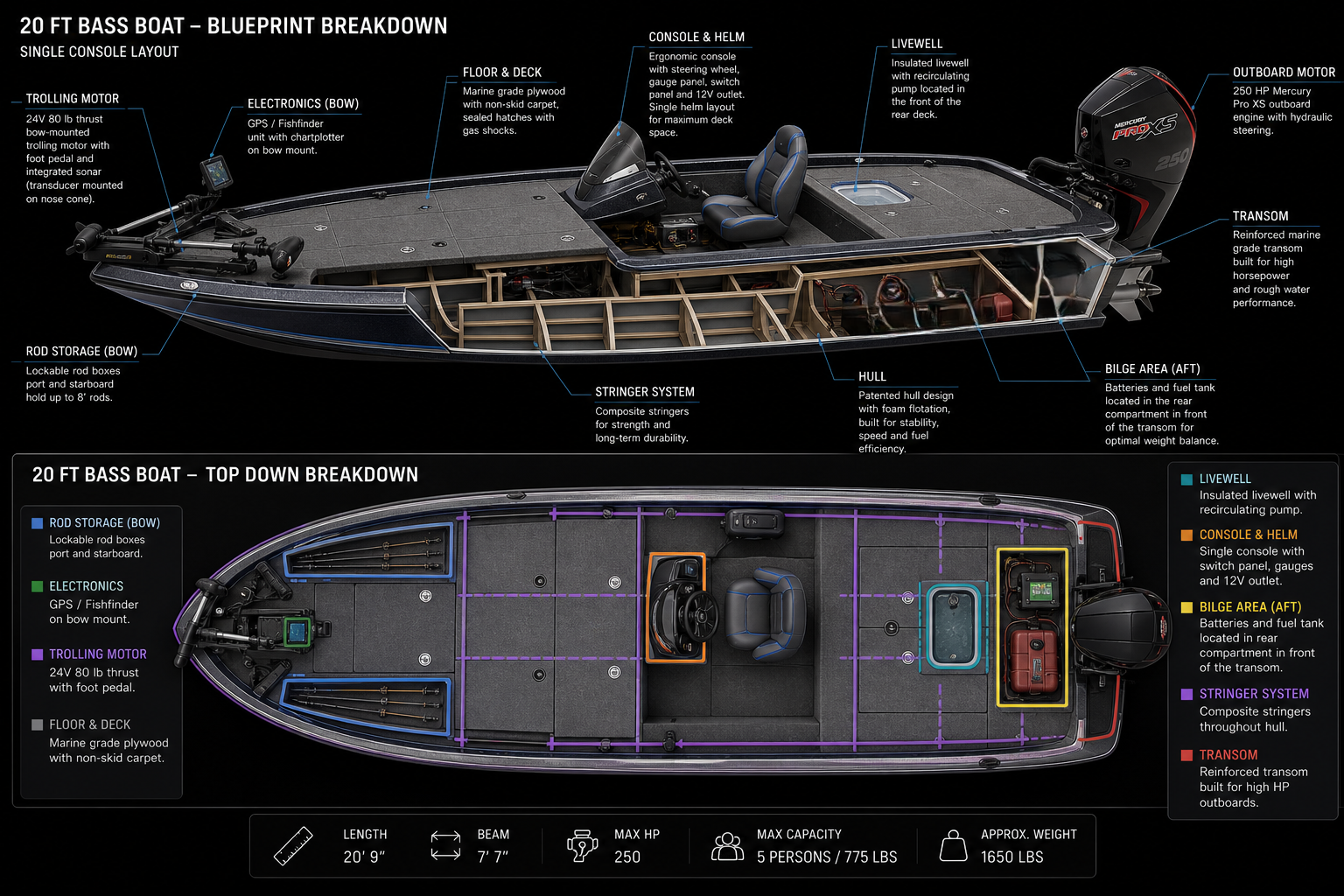
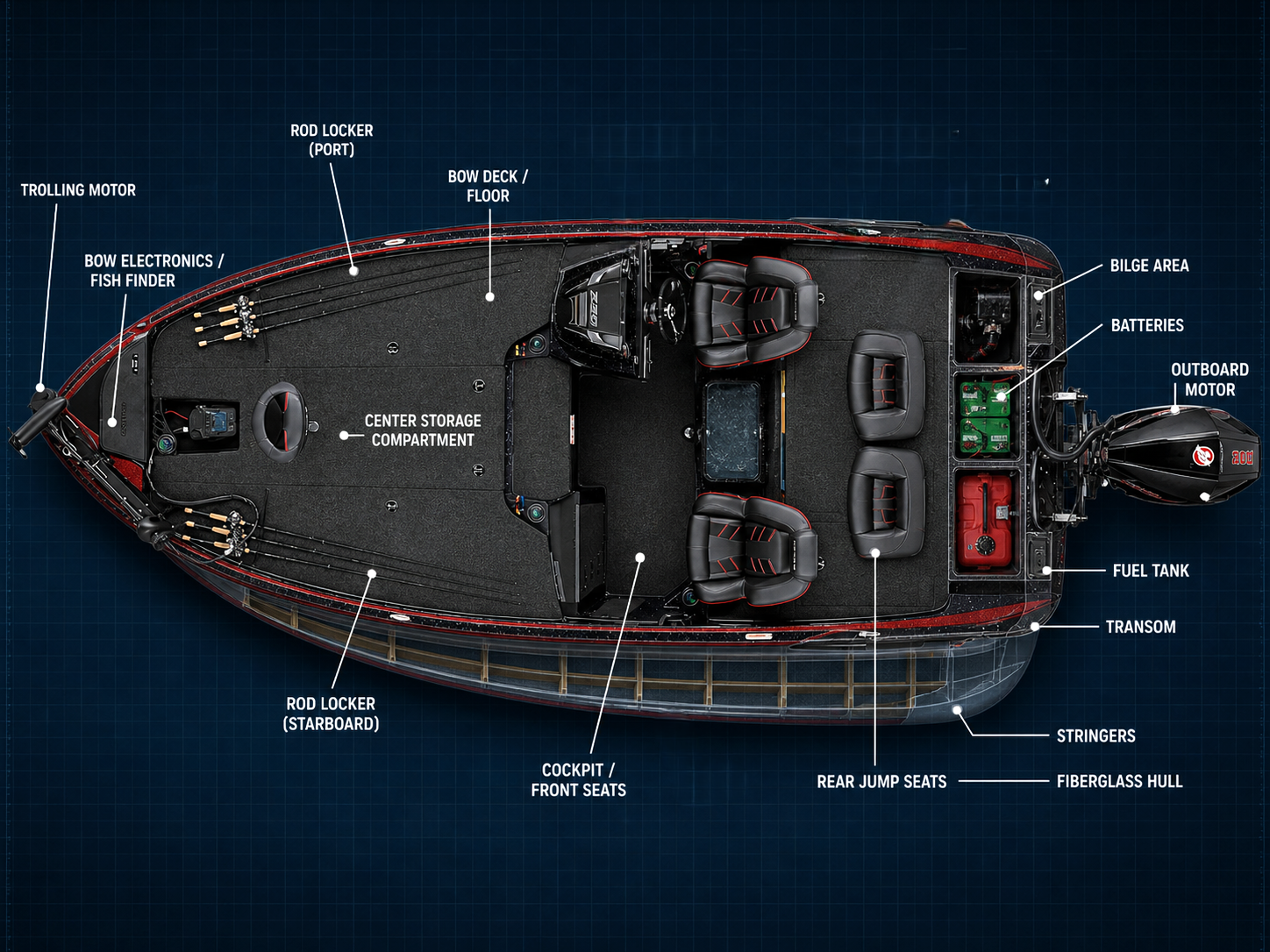
Understanding Bass Boat Construction
Before you can spot problems, you need to know how a bass boat is actually built. Every layer serves a purpose — and every layer can fail.
The Mold
Every fiberglass boat starts in a mold. A release agent goes down first, then gelcoat is sprayed or brushed on. This is your boat's skin — color, gloss, and UV protection. When this layer fails, everything underneath is exposed.
Laminate Schedule
Layers of fiberglass cloth (woven roving, chopped strand mat, or biaxial) are laid into the mold and saturated with resin. A typical bass boat bottom gets 3-5 layers, sides get 2-3, with extra reinforcement at the transom and strakes.
Core & Stringers
Stringers (longitudinal beams) and bulkheads are bonded to the hull with fillets and fiberglass tabbing. The transom gets a plywood or composite core sandwiched between glass. This skeleton carries every pound of motor, fuel, gear, and passengers.
Deck & Assembly
The deck is built separately, often with foam or plywood core, then bonded to the hull and stringers. Wiring, pumps, and plumbing are run before the top cap goes on. Once it's sealed, problems hide underneath until they're expensive.
Materials Breakdown
Not all fiberglass is the same. Not all resin is the same. Knowing the materials helps you understand why some repairs last and others don't.
Fiberglass Cloth
- Woven Roving — heavy, strong, used in hull bottoms and transoms
- Chopped Strand Mat (CSM) — conforms to curves, used in corners and transitions
- Biaxial / Triaxial — layers stitched together, no crimp, stronger per ounce
- Kevlar or Carbon — premium reinforcements in high-end hulls
Resin Types
- Polyester — standard, affordable, bonds well to gelcoat, but not the strongest
- Vinylester — better chemical resistance, tougher, bonds stronger to fiberglass
- Epoxy — strongest, most waterproof, best for structural repairs, but expensive
- We use vinylester or epoxy for structural repairs depending on the application
Core Materials
- Marine Plywood — traditional, affordable, but rots if water gets in
- Coosa Bluewater — composite, no rot, lighter than plywood, what we prefer
- Divinycell / Airex — foam core, used in decks and some transoms
- Balsa — very light, strong, but swells and rots instantly if wet
Marine Wiring
- Tinned Copper — copper coated in tin to resist salt corrosion. Non-negotiable.
- Solder-Seal Heat Shrink — adhesive + solder ring = waterproof connection
- AWG Gauge Matters — undersized wire causes voltage drop, motor strain, heat
- Ancor or Pacer Marine — the brands we use. Don't use automotive wire on a boat.
What to Look For — Inspection Checklist
Whether you're buying used or doing your annual check, here's what separates a sound boat from a money pit.
1The Tap Test
Walk the entire deck with a small hammer, screwdriver handle, or even your knuckle. Tap every square foot. A solid boat makes a sharp, crisp sound. A delaminated or saturated core makes a dull, hollow thud. Mark the soft spots — those are your problem areas.
2Transom Check
Look at the motor mounting bolt holes from the outside. Are they wallowed out? Is the gelcoat spiderwebbed around the bolt pattern? Grab the motor and try to rock it side to side — any movement means the transom is compromised. Look at the transom cap from inside the boat. Is it cracked, separated, or soft?
3Stringer Tabbing
Open hatches and look at where the stringers meet the hull. You should see clean, unbroken fiberglass tabbing — the 'stitches' that hold the stringers to the hull. If the tabbing is cracked, lifting, or missing, the stringers are loose. Push on the deck directly over each stringer. Movement means the bond is failing.
4Gelcoat & Hull
Walk around the hull looking for spider cracks, blisters, and chips. Small spider cracks are cosmetic. Cracks that radiate from fittings, strakes, or the transom are structural. Blisters — raised bumps under the gelcoat — mean water got between the gelcoat and laminate. One or two is manageable. Dozens mean a bigger problem.
5Wiring & Electrical
Follow the wiring from battery to console to motor. Is it automotive wire? Are connections twisted and taped? Is the bilge pump running slower than it should? Any of these means someone cut corners. Bad wiring causes fires, dead electronics, and dead batteries.
How Structural Repairs Actually Work
There's no magic — just proper technique, the right materials, and doing every step without skipping corners.
Diagnosis
We inspect, tap-test, and borescope if needed. We tell you exactly what's wrong, what's cosmetic vs. structural, and what happens if you wait. No guesses.
Diagnosis
We inspect, tap-test, and borescope if needed. We tell you exactly what's wrong, what's cosmetic vs. structural, and what happens if you wait. No guesses.
Strip & Prep
We cut out the bad material back to clean, dry, solid structure. We grind tapered bevels so each repair layer overlaps the one below it — the only way to get a lasting bond.
Strip & Prep
We cut out the bad material back to clean, dry, solid structure. We grind tapered bevels so each repair layer overlaps the one below it — the only way to get a lasting bond.
Rebuild
We install new core or stringers, bond them with proper fillets, and tab them in with biaxial glass and vinylester/epoxy resin. We match or exceed factory laminate schedules.
Rebuild
We install new core or stringers, bond them with proper fillets, and tab them in with biaxial glass and vinylester/epoxy resin. We match or exceed factory laminate schedules.
Fair & Finish
We fair the repair with epoxy fairing compound, gelcoat or prime, wet-sand through the grits, and buff. The repair should disappear. If it doesn't, we keep working.
Fair & Finish
We fair the repair with epoxy fairing compound, gelcoat or prime, wet-sand through the grits, and buff. The repair should disappear. If it doesn't, we keep working.
Systems & Wiring
If we opened up wiring, pumps, or plumbing, we put it back better than we found it. New tinned wire, sealed connections, labeled circuits, proper fusing.
Systems & Wiring
If we opened up wiring, pumps, or plumbing, we put it back better than we found it. New tinned wire, sealed connections, labeled circuits, proper fusing.
FAQ
Can I just patch it and keep fishing?
Sometimes, for purely cosmetic gelcoat damage. But if water is in the core, a patch just traps it. The rot spreads, the structure weakens, and the repair becomes 3x more expensive. If it's soft or squishy, it needs to come apart.
How long does a transom rebuild take?
Typically 2-3 weeks from drop-off to pickup. That includes strip, rebuild, cure time (resin needs to fully harden), fairing, finishing, and systems reassembly. We don't rush cure time — that's how repairs fail.
Is it worth fixing an old boat?
Depends on the hull, motor, and what it means to you. A 20-year-old hull with a good motor and trailer is often worth saving — especially if it's a model you can't buy anymore. We give honest assessments. We'll tell you if it's a money pit.
What's the difference between marine and automotive wiring?
Marine wire is tinned copper — every strand is coated in tin to resist corrosion. It's also rated for higher temperature and oil resistance. Automotive wire will corrode, break, and cause fires in a marine environment. We refuse to use it.
Why does my bilge pump run slower than it used to?
Almost always voltage drop from undersized wire, corroded connections, or a weak battery. We see boats wired with 18-gauge automotive wire running 20 feet to a pump. That pump is getting 9 volts instead of 12. We rewire with proper gauge tinned marine cable.
Can you match the original gelcoat color?
We can get very close — within a shade or two. For older boats with faded gelcoat, we may recommend respraying a larger section or the whole hull for a perfect match. We always discuss options and cost before we start.
Understand the Lingo
When we tell you the transom is delaminating or the stringers are saturated, you'll know exactly what we mean and why it matters.
Spot Problems Early
Small issues become expensive ones if you don't catch them. Knowing what to look for can save you thousands.
Make Informed Decisions
When you understand the work, you can tell good repairs from band-aid fixes. We want you to know the difference.
See Something That Sounds Like Your Boat?
Send us photos and we'll tell you honestly what's going on — what's urgent, what can wait, and what it'll take to fix it right.
Get a Free Assessment